


2026 Equity Outlook: Alpha in the AI Age

Rob Hinchliffe, CFA
Portfolio Manager, Head of Global Sector Cluster Research

Leo Harmon
Head of Equity Portfolio Management, MetLife Investment Management

Kenneth Ruskin, CFA
Director of Research and Head of Sustainable Investing – Global Equities

Christopher Pettine, CFA
Healthcare Analyst - Global Equities

John Song, CFA
Research Analyst

Michael Mark
Client Portfolio Manager, Equities
Global equities reached new highs in 2025, driven by the “Magnificent 7” tech giants, yet earnings results more broadly have yielded positive surprises. We see market opportunities extending well beyond tech in 2026, with agility and innovation critical for generating alpha, and active investors should find opportunities to capitalize on market mispricings as earnings growth broadens.
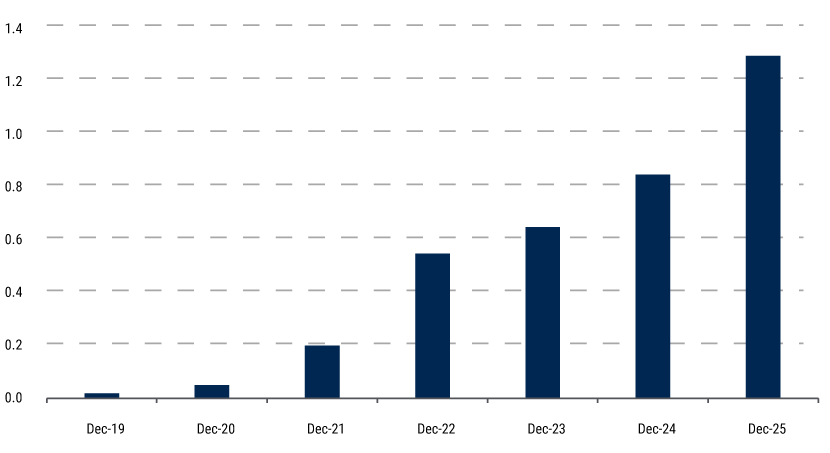
AI remains the dominant growth engine, driving heavy investment in datacenter infrastructure and cloud platforms. The resulting demand is expected to sustain robust annual growth in datacenter equipment, with industrial stocks benefiting from this trend.
AI’s influence extends beyond technology, catalyzing automation and near-shoring trends across industries. Companies that effectively leverage AI to boost productivity and gain competitive advantages – such as those achieving significant operational improvements – are likely to emerge as market leaders.
The consumer sector shows divergence: E-commerce and travel have rebounded strongly, while home goods and consumer staples lag. Consumer discretionary spending remains robust, but lower-income consumers face increasing pressure from inflation and reduced benefits, raising concerns for financial services, particularly in subprime lending.
Healthcare is showing early signs of recovery, with new pricing agreements and trade deals alleviating some sector headwinds. Innovation remains a key driver, with new obesity treatments and advanced medical devices expected to expand market opportunities. However, healthcare service providers continue to face challenges due to shifting funding and patient demographics.

Global equities climbed to new heights in 2025 despite trade and tariff turbulence and big questions about who will win and lose amid massive AI advancements and spending. Throughout the uncertainty, we have maintained our focus on identifying companies whose prospects are underappreciated by the market. And while the “Magnificent 7” tech giants continue to dominate stock market gains, earnings results more broadly have yielded positive surprises, and we see market opportunities extending well beyond tech in 2026.
Market Volatility Spiked in April Before Ebbing Back
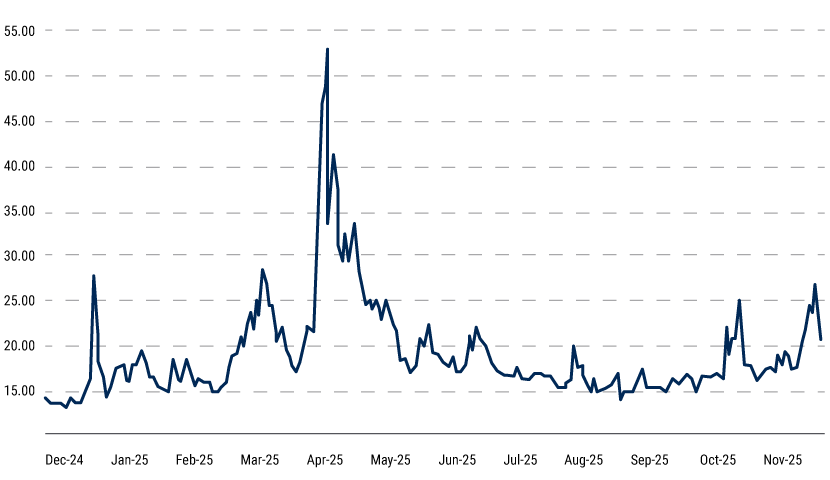
Source: VIX Volatility Index as of 25 November 2025.
AI’s impact: from tech to industrials and beyond
AI infrastructure development remains the leading tech growth engine, with hyperscalers investing heavily in datacenter expansion and AI monetization continuing to progress. Cloud platforms have witnessed mounting AI usage (as evidenced by growth in AI tokens), though their profitability remains mixed due to infrastructure costs and the need to evolve business models. Software, meanwhile, remains a “show me” story, with AI-driven disruption and the potential reallocation of IT budgets posing persistent concerns.
AI-Related Capex Is Accelerating
US AI-related capex – % GDP
US AI-related capex ($ Bil.)
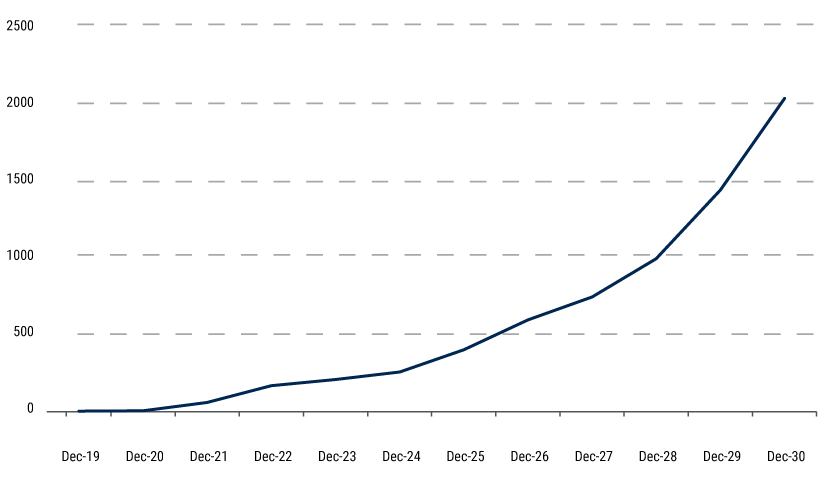
Source: MetLife Investment Management using approximated data from Wolfe Research. As of 30 September 2025. Past performance is not indicative of future results.
The ascendance of AI and its immense computational needs have driven an explosion of growth in the datacenter segment, and for industrial stocks the percentage of datacenter-derived revenue has become a key indicator of stock price performance. We view datacenter equipment growth as essentially locked in for the next four to five years, given outsized demand coupled with supply constraints related to electrical transmission and distribution and the electrical infrastructure. While forecasts vary, we believe these constraints should create relatively consistent annual growth of around 25% annually for datacenter equipment, while limiting the risk of datacenter overspending in the near term. With the strong recent performance of industrial stocks with datacenter exposure, we think a key question now is whether valuations are justified and offer upside at current levels.
The outlook is improving for semiconductor capital equipment companies (or semicaps), the “pick and shovel” firms that manufacture specialized machinery, tools, and systems used by chipmakers. Spending on wafer fabrication equipment is expected to rise in 2026, driven by a rebound in memory and continued investments in advanced logic. An improving outlook for leading global chip foundries will also support semicaps, though execution risks persist.
We remain bullish on AI’s long-term potential in industrial settings and expect it to drive continued demand for companies that supply the infrastructure to support its expansion. AI’s productivity-boosting benefits are also amplifying tailwinds in the form of rising automation and increased near-shoring: Near-shoring requires automation, which requires spending on automation, which AI helps to catalyze, creating a self-perpetuating cycle of demand.
While the impact of AI among tech and industrials is evident, we believe companies in any sector will be increasingly differentiated according to those that are using AI most effectively to boost productivity and gain enduring competitive advantages. Such first-mover advantages in AI adoption may separate winners from losers across industries – and recognizing the winners before the market will be a compelling source of alpha potential.
Divergence in the consumer sector
While the consumer sector has faced struggles in the post-Covid era, the experience has been far from uniform. E-commerce and digital companies continue to reap the benefits from a huge shift in shopping patterns, and travel and tourism – which were walloped by the pandemic – have seen a resurgence as demand for experiences soared, especially among higher-income consumers. On the other hand, areas such as home goods (which got a boost from the pandemic’s “homebody economy”) and, most notably, consumer staples companies such as food manufacturers have languished. That said, we’re seeing signs of revitalization among certain companies in the form of management changes and transformative restructurings, which could create opportunities at current valuations.
Critically, consumer discretionary spending has remained robust and is exceeding pre-pandemic levels despite persistent inflation and tariff fears. That said, a notable bifurcation has emerged between consumers at the mid to high end, which generally remain in good financial health, and those at the lower end: The latter appear to be bearing the brunt of recent slowdowns in income and employment growth. Accumulated inflation is tougher and the rollback in pandemic benefits bites harder for this segment, offsetting some of the stimulus from the recent tax bill.
The strain among lower-income consumers will be an area to watch in the financial services sector as well. While conditions look stable for now, with regulatory frameworks intact and credit quality generally remaining sound, concerns about credit issues among lower-end consumers in areas such as subprime auto loans, along with recent isolated incidents involving structured lending, may warrant closer monitoring in 2026.
Clouds part for healthcare
Some positive signs are emerging for the healthcare sector, which faced a persistent drag on sentiment and performance from policy challenges, pricing pressures, and tariff and regulatory uncertainties in 2025.
We have begun to see negotiations for more manageable pricing agreements between pharmaceutical companies and government insurance programs Medicare and Medicaid, which have alleviated some of the worst tail risks for pricing. At the same time, a cap of 15% on pharmaceutical imports was agreed to in recent bilateral trade deals between the US and key trading partners. These developments have led to a gradual recovery in the sector overall, as the future earnings impact of these new agreements is viewed as manageable.
Innovation continues to drive opportunities in healthcare. In 2026, we will see the expansion of obesity treatments to the broader population as lower-cost, easier-to-administer oral pill versions of the current injectable GLP-1s are introduced to the market. Medical device makers also continue to roll out impressive advancements in next-generation technologies, creating select opportunities.
Healthcare service providers remain the segment facing the greatest pressure. The expanded funding and access to government-sponsored healthcare that boosted these companies during the pandemic is now contracting, creating an “adverse selection” effect as healthier patients are pushed out of the pool. The result is a riskier patient population that exacerbates pricing challenges. We expect recovery to be slow, potentially materializing in late 2026 or early 2027, but will be watching for signs of a turnaround.
Agility and innovation will drive alpha in 2026
Contrary to the perception that investment opportunities are limited outside of the tech giants now dominating equities, we see a broadening opportunity set with alpha potential across markets for active investors. As earnings growth extends beyond the biggest names, we expect market participation to expand in parallel.
The heated debates and persistent uncertainties characterizing the equities markets today may in fact be a boon to active investing, providing opportunities for bottom-up investors to take advantage of the resulting mispricings to potentially generate alpha. We believe companies with the ability to innovate and respond quickly to AI’s opportunities and challenges, while navigating the ever-shifting currents of government policy and geopolitics, are best positioned for success. Those with the scale, flexibility, and pricing power to do so will likely come out on top and prove to be compelling longer-term investments.
For more insights into the trends moving markets in the coming year, see our 2026 Investment Outlook.

Disclosure
MetLife Investment Management (“MIM”), which includes PineBridge Investments, is MetLife, Inc.’s institutional investment management business. MIM is a group of international companies that provides investment advice and markets asset management products and services to clients around the world. The various global teams referenced in this document, including portfolio managers, research analysts and traders are employed by the various legal entities that comprise MIM.
All investments involve risk, including possible loss of principal; no guarantee is made that investments will be profitable. This document is solely for informational purposes and does not constitute a recommendation regarding any investments or the provision of any investment advice, or constitute or form part of any advertisement of, offer for sale or subscription of, solicitation or invitation of any offer or recommendation to purchase or subscribe for any securities or investment advisory services. The views expressed herein are solely those of MIM and do not necessarily reflect, nor are they necessarily consistent with, the views held by, or the forecasts utilized by, the entities within the MetLife enterprise that provide insurance products, annuities and employee benefit programs. The information and opinions presented or contained in this document are provided as of the date it was written. It should be understood that subsequent developments may materially affect the information contained in this document, which none of MIM, its affiliates, advisors or representatives are under an obligation to update, revise or affirm. It is not MIM’s intention to provide, and you may not rely on this document as providing, a recommendation with respect to any particular investment strategy or investment. Affiliates of MIM may perform services for, solicit business from, hold long or short positions in, or otherwise be interested in the investments (including derivatives) of any company mentioned herein. Views may be based on third-party data that has not been independently verified. MIM does not approve of or endorse any republication of this material. This document may contain forward-looking statements, as well as predictions, projections and forecasts of the economy or economic trends of the markets, which are not necessarily indicative of the future. Any or all forward-looking statements, as well as those included in any other material discussed at the presentation, may turn out to be wrong.