


2026 Investment Grade Credit Outlook: A Turning Point in a Familiar Market?

Stephen Mullin, CFA
Head of Investment Grade Portfolio Management, Public Fixed Income, MetLife Investment Management

Robert Vanden Assem, CFA
Head of Developed Markets Investment Grade Fixed Income
Big shifts are beginning to take place beneath the surface of a familiar IG credit market, with a surge in AI-related capex, a pickup in merger and acquisition activity, and a likely rise in long-duration issuance all reshaping the supply-demand balance.
Given rich valuations and asymmetric risk-return dynamics, we favor a selective, defensive, and opportunistic approach marked by conservative carry, a shift into lower-dollar-price bonds, and maintenance of Treasury allocations, looking to buy on weakness and avoid both over-loved and challenged credits.
Security selection remains a powerful driver of performance, and at this stage in the cycle, alpha often comes from what investors don’t own – including issuers with excessive leverage plans, those trading at extremely tight levels, and companies engaging in aggressive shareholder returns.
From a sector view, we believe banks look compelling, while we see rich industrial valuations and expect idiosyncratic rather than thematic performance to provide select opportunities, with technology warranting caution amid heavy supply. The utilities sector has grown increasingly issuance-heavy, though defensive opportunities persist.

In the early months of 2026, the investment grade (IG) credit market looks much as it did over the prior two years. Yields remain elevated, offering investors compelling carry, while spreads sit near multi-decade tights – levels last visited in the mid-1990s. Despite this rich starting point, markets continue to deliver positive excess returns, supported by unusually strong technical conditions and resilient corporate fundamentals.
Yet beneath the surface, big shifts are beginning to take place. A surge in capital expenditures linked to artificial intelligence (AI), a reacceleration in merger and acquisition (M&A) activity, and a likely inflection in long-duration issuance are all reshaping the supply-demand balance. After years when persistent inflows suppressed volatility and kept spreads contained, 2026 is shaping up to be a year in which technicals may finally loosen their grip.
The question for IG investors is not simply whether spreads can tighten further – few believe valuations are compelling at these levels – but whether changing market dynamics will generate the kind of dispersion and volatility that create alpha opportunities for active managers. Here we examine the forces shaping the 2026 investment grade credit markets and look at strategies to navigate a landscape where supply is rising, demand may be tested, and credit selection is poised to matter even more than it has in recent years.
Investment Grade Spreads Are Historically Tight
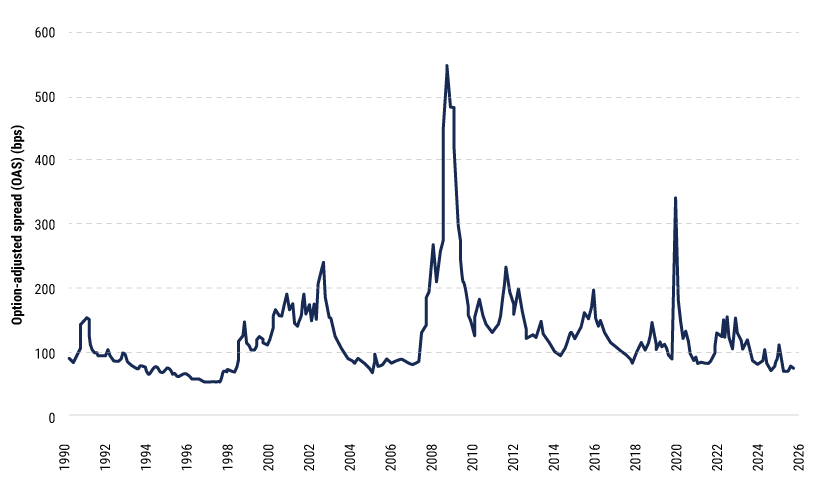
Source: Bloomberg U.S. Aggregate Corporate OAS Index, using daily data, as of 16 February 2026.
Technicals at a crossroads: the AI-driven shift in supply
A defining theme entering 2026 is the dramatic increase in issuance from tech companies embarking on massive AI-related capex programs. What began in late 2025 with a record $27 billion datacenter-backed security from Meta quickly cascaded into a wave of mega-deals from leading hyperscalers. Combined, Meta, Oracle, Google, and Amazon raised more than $100 billion in the fourth quarter alone – an issuance surge that marked the clearest inflection point in technicals since the pandemic.
Historically, these firms operated from “fortress” balance sheets, with high-quality ratings, deep cash reserves, and limited reliance on debt financing. But the scale of the AI infrastructure buildout has shifted behavior. Industry estimates suggest AI-related capex could approach $600 billion in 2026 and $4 trillion cumulatively through 2030, a magnitude that virtually guarantees an elevated pace of investment grade issuance in the years ahead.
AI-Related Issuance Has Soared
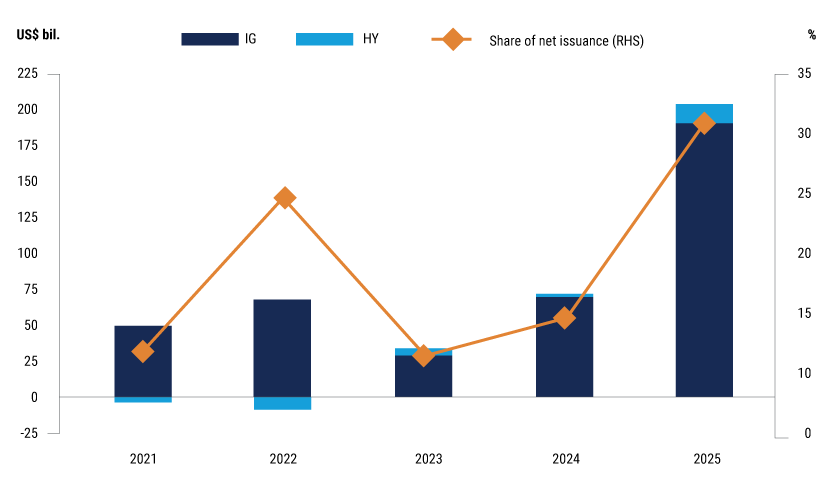
Source: Goldman Sachs FICC and Equities, Goldman Sachs Global Investment Research, and Bloomberg as of 16 February 2026.
Compounding the impact, the maturity profile of issuance is shifting. The average tenor in fourth-quarter 2025 jumped to 13 years (from 10 previously) as issuers moved decisively toward the long end of the curve. This is a marked reversal from the prior trend, when supply favored short maturities and reinforced flattening in credit curves.
The implications for technicals are profound. For the first time since 2022, supply may meaningfully outpace demand, eroding the imbalance that has buoyed spreads at historically tight levels. With 2026 capital market forecasts as high as $2.25 trillion1 – a staggering 35% year-over-year increase in high grade bond issuance – market participants must prepare for conditions in which more bonds may finally mean wider spreads.
Demand is strong, but not infinite
Demand remains resilient entering 2026, underpinned by elevated yields that continue to attract retail and institutional buyers alike. Insurance companies, foreign investors, and US retail flows remain key pillars of support.
The durability of demand is not guaranteed, however, and several factors could challenge the absorption of heavier supply. These include:
The interest rate path. The Fed is expected to begin easing in the second half of 2026, with roughly three rate cuts anticipated. Lower yields may dampen demand from rate-sensitive buyers who prefer locking in higher coupons.
Market dislocations. Unexpected shocks from geopolitical tensions, abrupt policy shifts in Japan, currency volatility, or US midterm election uncertainty could temporarily impede flows.
Retail behavior. Retail investors have become a surprisingly powerful influence on IG performance. Their flows, historically pro-cyclical and sensitive to shifts in sentiment, may introduce volatility if markets experience bouts of weakness.
Overall, we believe demand will remain healthy but may not fully offset the surge in longer-duration issuance – an evolving balance that could be an important determinant of spread direction in 2026.
Corporate fundamentals are solid, but more nuanced
Corporate issuers entered 2026 in generally good financial condition. Leverage has stabilized, cash flow remains healthy for most sectors, and early earnings reports suggest that balance sheets are well-positioned to weather moderate economic slowing.
That said, a risk frequently cited is that massive AI investments fail to generate the anticipated returns. For now, this risk is mitigated by exceptionally strong balance sheets among hyperscalers, along with ample free cash flow and ongoing capacity to raise equity or term out maturities.
Oracle’s experience can serve as a case study in which large and highly visible issuance was offset by equity raises to preserve the company’s investment grade status. But it is also a reminder that even high-quality issuers can become “beta names” within a thematic cycle. Spreads may become more volatile, and differentiation more pronounced.
Rising M&A also affects fundamentals. While M&A can be credit-positive for financial firms – supporting consolidation, scale, and synergies – it is often credit-negative for non-financial corporates such as industrials. Debt-financed acquisitions have historically introduced spread widening pressures, particularly late in the credit cycle. With 2026 expected to bring an uptick in strategic M&A, investors must remain alert to potential balance-sheet degradation.
Macro backdrop calls for moderate spread widening, careful yield curve positioning
The macro outlook for 2026 is one with its own set of sensitivities. While the expectation among many economists is moderate growth, sticky inflation, and gradual policy easing, the unforeseen still looms. Deficits appear stable; however, US spending supported by OBBBA-related refunds has the potential to increase, and labor markets are still largely fragile. Many observers see a “slow-hire, slow-fire” environment, though it is hard to ignore large-scale headline layoffs among US technology leaders.
The Fed is expected to adopt a more neutral policy stance following the appointment of new leadership in the second half of the year. Although a decrease in long-end Treasury issuance may help anchor yields, the market could quickly reassess the Fed’s effectiveness on taming inflation, potentially resulting in higher long-term yields.
For IG investors, the shape of the yield curve – particularly the 10s/30s curve, which remains flat but may steepen – will have significant implications for curve positioning and relative performance across maturities. At 25-year tights, spreads leave little risk premium to absorb shocks. Yet history has shown that even when spreads widen from such tight levels, markets often stabilize quickly as buyers reenter.
We see a few key reasons why spreads may widen in 2026:
A surge in long-duration supply, especially from tech
M&A-related issuance from industrials and utilities
Greater concessions on large financings, which could reprice curves
A shift in technicals from supply-constrained to supply-heavy
Potential exogenous shocks at a time of thin cushions
We don’t expect widening to be disorderly, however. While fundamentals remain generally sound, elevated starting yields, along with global demand, should mitigate the potential for significant spread decompression. The more likely outcome is moderate widening and more dispersion, creating opportunities for security selection rather than broad beta trades.
We continue to favor the front end and the belly of the curve, with strong roll-down, attractive breakevens, and the expectation of further long-duration supply all arguments for staying inside the long end. The long end is likely to underperform in excess-return terms given upcoming multi-year hyperscaler issuance, the potential steepening in the 10s/30s curve, and elevated volatility risk.
Sector-specific views: where to play (and where to be careful)
Financials: Banks looking compelling. Senior bank debt remains attractive, with supportive factors including a steeper yield and credit curve, potential M&A tailwinds, rate cuts (which would help profitability), and cleaner balance sheets after 2025 loan repricings. Subordinated debt and non-bank financials are less favored due to structural risks and limited spread compensation.
Industrials: rich valuations and credit-specific opportunities. Industrial credit curves are flat, and valuations are stretched. Late-cycle risks include shareholder-friendly actions, leveraged buybacks, and debt-financed acquisitions. We believe the sector’s performance will likely be idiosyncratic rather than thematic, providing select opportunities.
Technology: caution amid heavy supply. While the tech sector retains strong fundamentals, 2026 will test the market’s ability to absorb substantial issuance. The sector’s weight in IG indices is likely to rise from roughly 8% to around 10%, adding about $200 billion in supply. Expect more volatility around headline-driven capex plans, along with wider dispersion among the most active issuers. We also see active management opportunities, especially in the long end.
Utilities: becoming more issuance-heavy, yet defensive opportunities remain. Utilities benefit from stable cash flows and secular growth from datacenter power needs, though several market realities create supply pressure that we believe warrants a more cautious stance. These include AI-induced power demand (expected to rise to 3%-4% of global electricity usage from 1.5% currently), potential for elevated multi-year capex, and regulatory uncertainties.
Emerging markets IG: riding on a strong 2025. Investment grade EM credit was a standout performer last year, benefiting from spread compression. The outlook is more neutral for 2026, with valuations less compelling, issuance ticking up, and enthusiasm more tempered, though tactical opportunities remain.
IG investment strategy: conservative carry with selective risk-taking
Security selection, and particularly identifying underfollowed or under-loved stories, remains a powerful driver of performance. Given rich valuations and asymmetric risk-return dynamics, we favor a selective, defensive, and opportunistic approach, marked by:
Conservative carry. Prioritizing carry from high-quality, well-positioned issuers rather than reaching for spread tightening potential.
Shifting into lower-dollar-price bonds. Rotating into lower-dollar-price issues of the same issuer enhances risk mitigation if spreads widen.
Maintaining Treasury allocations. Treasuries serve as a buffer against bouts of spread volatility and provide dry powder for reentry.
Buying on weakness. Given historically strong re-risking behavior after spread widening, pullbacks may represent attractive opportunities.
Avoiding over-loved or challenged credits. At this stage in the cycle, alpha often comes from what investors don’t own, including names with excessive leverage plans, issuers trading at extremely tight levels, and companies engaging in aggressive shareholder returns.
Opportunities in a year of transition and renewed dispersion
After several years defined by rich valuations, muted volatility, and powerful technical support, 2026 is shaping up as a transition year for investment grade credit.
The AI capex boom is the most significant supply-side development in a generation, pulling a traditionally conservative set of issuers into more active financing cycles. Combined with rising M&A activity and a normalization of the maturity profile toward longer tenors, the result is a meaningful rebalancing of supply and demand.
Yet this does not imply a bearish outlook. Elevated yields, healthier secondary-market liquidity, and resilient corporate fundamentals should continue to support positive total returns. The shift instead suggests that beta may take a backseat to alpha, and that security selection and curve positioning will be far more consequential than in the compressed markets of 2023-2025.
Ultimately, 2026 may be remembered as the year dispersion returned: a market in which investors spent more time discussing the bonds they avoided than the ones they owned, and in which patience, selectivity, and disciplined positioning were rewarded as technicals normalized and opportunities widened.
For more insights into the trends moving markets this year, see our 2026 Investment Outlook.
1 Source: Morgan Stanley, “2026 Investment Outlook: U.S. Stocks Shine in Spotlight of Favorable Conditions,” 19 November 2025.
Disclosure
MetLife Investment Management (“MIM”), which includes PineBridge Investments, is MetLife, Inc.’s institutional investment management business. MIM is a group of international companies that provides investment advice and markets asset management products and services to clients around the world. The various global teams referenced in this document, including portfolio managers, research analysts and traders are employed by the various legal entities that comprise MIM.
All investments involve risk, including possible loss of principal; no guarantee is made that investments will be profitable. This document is solely for informational purposes and does not constitute a recommendation regarding any investments or the provision of any investment advice, or constitute or form part of any advertisement of, offer for sale or subscription of, solicitation or invitation of any offer or recommendation to purchase or subscribe for any securities or investment advisory services. The views expressed herein are solely those of MIM and do not necessarily reflect, nor are they necessarily consistent with, the views held by, or the forecasts utilized by, the entities within the MetLife enterprise that provide insurance products, annuities and employee benefit programs. The information and opinions presented or contained in this document are provided as of the date it was written. It should be understood that subsequent developments may materially affect the information contained in this document, which none of MIM, its affiliates, advisors or representatives are under an obligation to update, revise or affirm. It is not MIM’s intention to provide, and you may not rely on this document as providing, a recommendation with respect to any particular investment strategy or investment. Affiliates of MIM may perform services for, solicit business from, hold long or short positions in, or otherwise be interested in the investments (including derivatives) of any company mentioned herein. Views may be based on third-party data that has not been independently verified. MIM does not approve of or endorse any republication of this material. This document may contain forward-looking statements, as well as predictions, projections and forecasts of the economy or economic trends of the markets, which are not necessarily indicative of the future. Any or all forward-looking statements, as well as those included in any other material discussed at the presentation, may turn out to be wrong.

Recent Insights