


Capital Market Line: The Pivot Driving a Pickup in US Growth

Michael J. Kelly, CFA
Global Head of Multi-Asset

Hani Redha, CAIA
Portfolio Manager, Head of Strategy and Research for Global Multi-Asset

Steven Lin, CFA
Portfolio Manager, Global Multi-Asset

Peter Hu, CFA, FRM
Portfolio Manager, Global Multi-Asset

Sunny Ng, CFA
Portfolio Manager, Global Multi-Asset

Mikhail Johaadien
Research Analyst, Global Multi-Asset

Teresa Wang
Vice President, Research Analyst, Global Multi-Asset

In a country long criticized for too much consumption and too little investment, the US appears to be entering a deliberate transition in policy and growth. In the post‑Covid years, US growth was heavily powered by government outlays and fiscal activism. Now, private‑sector investment is steering the US economy, with occasional government outlays for national security purposes. Making this pivot is easier said than done, but the scale of the AI investment and constraints on the pace of expansion (e.g., electricity and copper supply) ensure that it will remain a dominant driver for years to come.
Unlike the narrow internet‑driven boom of the 1990s, today’s investment wave spans multiple sectors: artificial intelligence, power infrastructure, and, soon, blockchain, once clarifying legislation linked to the Genius Act is in place. Crypto itself is also evolving, from a vehicle for speculative trading toward a more functional payment and transaction system. With this shift, the financial services industry is likely to invest heavily in modernizing legacy infrastructure to enable broader digital transactions. Depending on the outcome of the midterm elections, a renewed reshoring wave could extend this capital‑spending cycle beyond 2026.
Today’s remixing of growth drivers – with private investment rising and consumption steady as households draw down excess savings – points toward a reacceleration in US growth, with much longer legs than the brief stimulus provided by the OBBBA kicking in soon. The ongoing AI‑driven capex boom, thought to be productivity-enhancing and thus disinflationary over time, continues to underpin the recovery in financial markets. Should that transpire, the “Sell America” trade will prove self-defeating.
While it is natural to seek parallels to the late‑1990s internet boom, we see as many differences as similarities in today’s AI investment cycle. The internet’s rapid ascent in the mid‑1990s was defined less by real use cases and more by cash‑burning concepts built on the assumption that “if you build it, they will come.” Most of those business models relied heavily on markets for continuous financing until they could aggregate enough eyeballs to sell advertising. When that patience ran out in early 2000, the bubble burst, well before the true “killer apps” of the internet economy emerged. Facebook’s 2004 debut and the iPhone’s 2007 launch ultimately paved the way for mass‑market applications that made the internet indispensable, but these successes came years after the speculative excess had tipped over.
Today’s AI cycle appears far more grounded. Although much trial and error followed ChatGPT’s introduction two years ago, technological progress has been rapid. Model capabilities now approach expert‑level competency in several fields, and the range of tasks AI can perform is doubling roughly every seven months. Demand is surging as well: Google reported a 5,000% year‑over‑year increase in inferencing tokens as of April 2025, a metric that doubled again within months. Capacity has yet to catch up, and the resulting bottlenecks hardly resemble the empty‑demand conditions of 2000. Hyperscalers now view AI leadership as existential, prioritizing scale and speed over capital frugality. Even so, today’s investor anxiety about elevated capital spending provides useful discipline, encouraging management teams to align outlays more closely with revenue realization.
The funding backdrop also differs materially from the late 1990s. Then, all equity financing was predicated on unending patience for financing cash-burning models as they pursued eyeballs that were slow to appear; today, the buildout is grounded in strong Capital Market Line Quarterly Five-Year Forecast of Relative Risk and Return Across Asset Classes December 2025 PineBridge Investments Capital Market Line | 2 balance sheets and deep cash flow. After their latest rounds of capex acceleration, the hyperscalers are still expected to deliver positive free cash flow exceeding total capex or debt issuance through 2026‑2028. While debt markets are contributing, Meta and Google issued $27 billion in 25‑year and $15 billion in 50‑year private‑credit paper, respectively. These amounts reflect longer‑duration financing rather than liquidity stress. Rising long‑dated issuance may drive some curve steepening, not because of stress but due to demand for duration financing of productive investment.
To the extent that a “speed limit” emerges, it will likely come from physical and policy constraints rather than market exhaustion. Power availability, regulatory scrutiny, and credit discipline around potential obsolescence provide natural checks on overbuilding. Fundamentally, a stabilization in growth at an extremely high level, yet lengthening in duration at that rapid pace, is highly constructive. Marketwise, however, it will require a transition of ownership from second-derivative momentum-chasers to long-term-oriented growth investors, a process that has already begun. We contend that fast and steady will win the race.
Still, the macro behavior of global capital today rhymes with historical patterns. In the late 1990s, investors sought exposure to the greatest innovation wave of the time, concentrating funds into US assets tied to the internet revolution. We expect a similar pattern in 2026, particularly once AI spreads to applications and beneficiaries, and soon thereafter blockchain kicks in as another independent growth engine. China is ramping quickly yet is still a distant second. Meanwhile, investment flows should again gravitate toward the early beneficiaries of both themes, which will be found predominantly in the US. This could reinforce the US market. The next stage of AI leadership, potentially humanoid technologies, will likely tilt toward China later in the decade. For now, however, the US retains a clear technological and financial lead.
Ultimately, we see this phase not as a speculative crescendo but as the start of a “micro” version of US exceptionalism, which for several years post-Covid was largely explained by a ramp-up in fiscal policy as other nations sat on their hands. Green shoots are likely to emerge first among AI users and software platforms that convert infrastructure into efficiency, productivity, and profits. With investors worldwide needing US dollars to access these opportunities, capital inflows will likely continue to bolster US assets. We don’t see a structurally weak US dollar should the US growth rate inflect higher vis-à-vis global growth, as it did in the 1990s. In our view, the current AI investment cycle reflects rational exuberance, not a late‑stage bubble.
This renewed US dynamism stands in contrast to a still sluggish, if somewhat improved, global backdrop. Post‑Covid fiscal activism by the US was easily absorbed when other fiscal authorities were sitting on their hands and private investment was scarce. That was then. Now, many governments are seeing rising demands by their constituents paired with a need to boost defense budgets – all while very low-cost debt is maturing and will need to be reissued amid not only a higher fiscal deficit to GDP, but also much higher rates than the maturing coupons. No surprise that fiscal sustainability is increasingly being questioned. The way out, of course, has typically involved repressing rates at the short end of yield curves to repress one’s currency. That prospect has lit up gold.
In Europe, the investment story is finally moving along. Germany unveiled a €130 billion state‑backed “Germany Fund” aimed at mobilizing strategic industrial investment and amassing private participation in critical technologies, energy transition, and infrastructure. Complementing this, draft legislation that would expand private pension savings, potentially unlocking new equity allocations, marks an important structural shift for German households, long reliant on low‑risk savings instruments. Together, these steps suggest a gradual pivot toward equity‑driven capital formation, a meaningful departure from the region’s historically conservative investment model. Other European economies are likely to follow similar paths, blending fiscal incentives with pension reforms in an effort to rejuvenate weak productivity and counterbalance competitive pressures from both the US and China.
China stands apart, with private‑sector investment and broad consumption both weakening sharply. Much of the pullback appears tied to anti‑involution policies designed to curb local‑level overinvestment and reduce systemic inefficiencies. Historically, such reform episodes have been accompanied by targeted liquidity injections – the 2015‑2016 supply‑side reforms saw spillover into real estate; this time, initial support for growing the PBOC’s monetary aggregates appears to have ended. This is a policy mix now aimed solely on exporting, with those benefits eventually finding their way to the populace.
Expanding fiscal deficits in most developed countries, plus a once‑in‑a‑generation private investment wave in AI and infrastructure (along with all the electricity investments required), look set to start draining the global supply glut. Over time, this will drive a higher real rate and a structural steepening of yield curves. Should AI productivity tame service inflation, the overall impact on the yield curve may not be too harsh. In such an environment, secular growth assets that can outpace higher long‑term rates are poised to outperform, while defensive fixed income faces mounting pressure from rising yields and firmer inflation expectations.

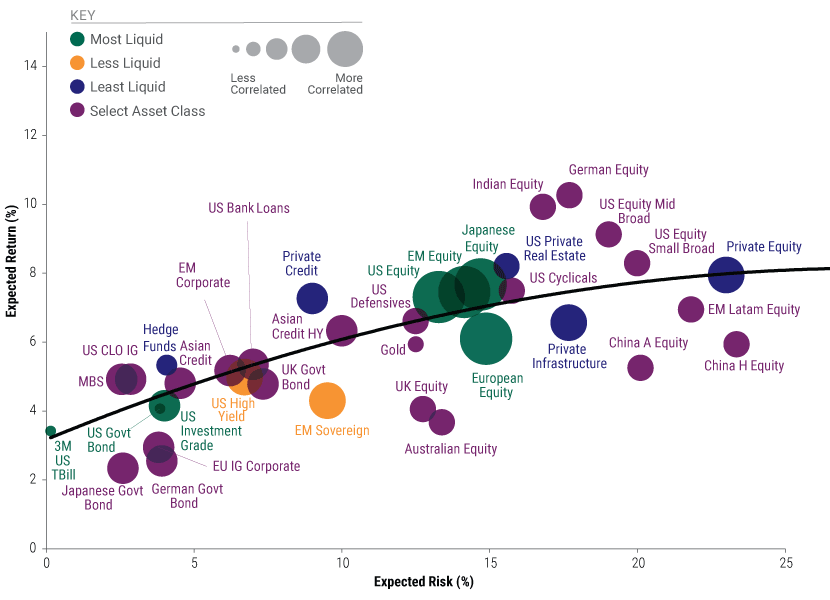

Capital Market Line as of 31 December 2025 (Local Currency)
Please see Capital Market Line Endnotes. Note that the CML’s shape and positioning were determined based on the larger categories and do not reflect the subset categories of select asset classes, which are shown relative to other asset classes only.
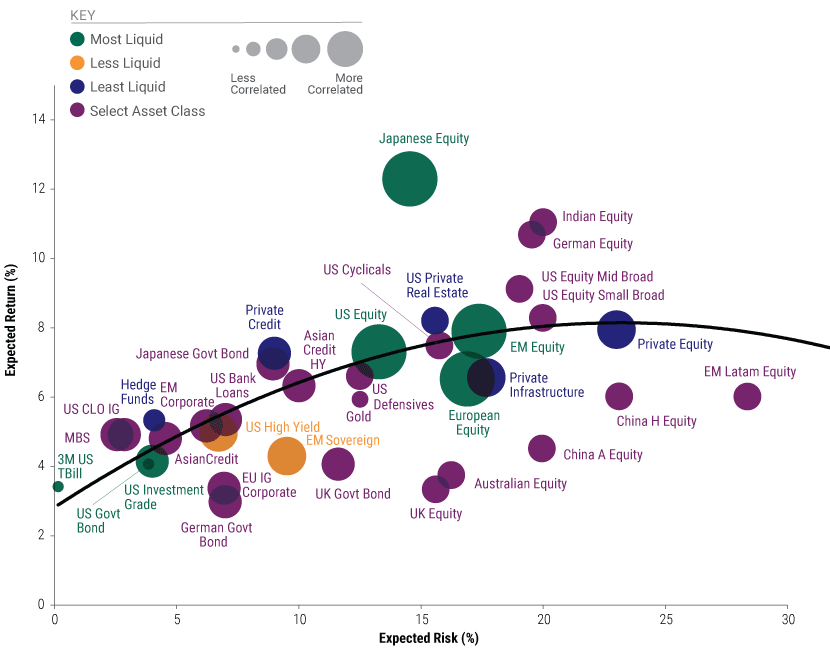
Capital Market Line as of 31 December 2025 (USD View, Unhedged)
Please see Capital Market Line Endnotes. Note that the CML’s shape and positioning were determined based on the larger categories and do not reflect the subset categories of select asset classes, which are shown relative to other asset classes only.
Insights From Today’s CML
Our Capital Market Line (CML) is flatter but shows greater dispersion. This move is driven by powerful shifts in geopolitics, policy, and the disruption ahead, with larger winners and losers emerging as the impacts of AI begin to manifest. The coming years will see efforts to address unsustainable trends that have built up over decades, leading to significant changes in cash flows. These dynamics are generating both risks and opportunities, fueling the current high dispersion. We expect this era of transformation to spur investment and put upward pressure on real interest rates. Our approach is to capitalize on medium-term opportunities created by lasting technological and geopolitical changes that lead to structural upgrading of certain pockets in the market.
Focus on equities amid reacceleration. We are in the reacceleration camp, particularly in the US, with markets likely to gravitate back to US-centricity in 2026. Markets should recenter on the US for micro reasons, as investors remain underweight amid macro policy noise. US firms will lead the first AI application wave (agentics), with China following years later with humanoid robots. While we’re conscious of the risks of hyperscalers and others overinvesting in AI infrastructure, we don’t think these risks will manifest in the next year or two. We have nonetheless begun to evolve the focus within our Productivity basket toward applications that we expect to be the first beneficiaries of AI datacenter and model buildouts (and to benefit even more if the AI infrastructure is overbuilt). And productivity gains are poised to benefit sectors well beyond tech. In the UK, an uptick in London office rents and tax hikes released in the UK budget will keep rates drifting down, benefiting UK REITs. An energy policy shift toward nuclear power, which is the power source of choice (if not necessity) for AI, is benefiting our New Energy basket.
Further pressures at the very long end. While global developed market (DM) sovereigns have become more fiscally active, a key differentiator among them will be those whose private sectors are less vibrant with respect to investing and issuing debt to compete with the sovereign. We continue to find DM sovereign maturities over 10 years unattractive. Credit thrives where the investment appetite is tepid. Between datacenter buildouts in the US and the enormous amount of new electricity they require, along with shifts in supply chains around the world, we see funding pressures emerging at the very long end that haven’t been witnessed for decades.
Go to where the issuance is not. We continue to favor Asian high yield (ex China property), yet we are now also interested in a handful of LatAm bonds. We also see patches of relative value in select private versus public markets amid rising rates, with a focus on high-quality tranches within private credit, including infrastructure and asset-backed finance (ABF) markets.
Alternatives are important diversifiers. Gold remains one of the few safety assets whose diversification benefits to equity and bond risk actually improve as we move toward a “run hot” environment. This creates an important diversification value for gold in a portfolio context. As fiscal deficits rise while low-rate coupons are replaced with higher coupons, and fiscal sustainability becomes stressed, the prospect of currency debasement versus gold rises. Crypto never appealed to us as a store-of-value alternative, as it remained far too volatile to spawn transaction-based use cases. Its use has remained largely constrained to speculation. In the year ahead, blockchain-based migration will give rise to investments (as opposed to speculation) whose values are tied to increasing transactions using the technology, a topic we plan to comment on in the coming months.
The Fundamentals Driving Our CML
Transitioning to more balanced public and private sector growth. Following the global financial crisis, Western economies faced mild balance sheet recessions, defined by weak consumption and investment as the private sector deleveraged. The tension between reduced private investment and a high savings propensity – which typically depresses interest rates – was amplified by unconventional monetary policies, such as quantitative easing and negative rates. Fiscal policy remained largely passive, leaving monetary authorities to do most of the heavy lifting. This “old abnormal” persisted until around 2015, when our CML cash flow growth projections began showing weaker growth but more generous capitalization assumptions. Since then, growth has strengthened alongside healthier household and corporate balance sheets and broader secular shifts. The post‑pandemic period brought aggressive fiscal expansion, but we viewed that as a temporary, fragile version of US exceptionalism. The second Trump administration now seeks to rebalance growth by scaling back government support and transferring momentum to the private sector. While this transition may cause near‑term frictions, we see it as a necessary adjustment to lay a more durable, investment‑driven foundation for long‑term growth.
China is easing to offset anti-involution policies. China’s anti‑involution campaign has slowed investment and production, creating a need for policy support. Policymakers now view a rising equity market as the preferred offset – channeling liquidity toward stocks while curbing excess capacity in traditional and advanced manufacturing. With the PBOC intent on keeping the yuan stable against the US dollar in nominal terms, yet devaluing it in real terms, it appears to be backing off rapid balance sheet growth to inflate assets like stocks, providing an offset to continued declines in real estate values.
Germany’s fiscal stance shifts from restraint to renewal. After years of adhering to a strict debt brake that constrained public investment, Berlin is now loosening fiscal limits to launch a €500 billion plan over 12 years, targeting infrastructure, defense, and climate projects. This pivot – reflecting strong public support for modernization – marks a significant departure for a traditionally debt‑averse nation. The initiative enables higher defense spending and greater borrowing flexibility for Germany’s federal states, restoring fiscal momentum to a key European growth engine. Though domestically driven, this German fiscal reboot is poised to lift growth prospects across the euro area, complementing the broader global reinvestment cycle.
Tariffs and other geopolitical risks lead to shifts in supply chains. Higher trade barriers are accelerating the move toward deglobalization, prompting firms to reshore production and diversify sourcing. As companies prioritize reliability over cost efficiency, supply‑chain reconfiguration is pushing up input costs and keeping medium‑term inflation pressures elevated. At the same time, these strategic and geopolitical realignments are driving a new wave of capital investment, particularly in technologies and processes that enhance productivity and reduce dependency on volatile global links.
AI as a catalyst for productivity. Advances in artificial intelligence and broader human‑capital investment are transforming labor markets, business models, and competitiveness. Generative AI is poised to automate a meaningful share of routine tasks, lifting labor efficiency, creating new roles, and broadening the reach of innovation across industries. These gains are already reinforcing US economic resilience, paving the way for faster secular growth and productivity‑led disinflation. In parallel, China is intensifying its efforts in AI and robotics, positioning itself as a leader in the global humanoid rollout – a shift that signals the arrival of “embodied AI,” where software intelligence meets physical capabilities.
Capital Market Line Endnotes
The Capital Market Line (CML) is based on PineBridge Investments’ estimates of forward-looking five-year returns and standard deviation. It is not intended to represent the return prospects of any PineBridge products, only the attractiveness of asset class indexes, compared across the capital markets. The CML quantifies several key fundamental judgments made by the Global Multi-Asset Team for each asset class, which, when combined with current pricing, results in our annualized return forecasts for each class over the next five years. The expected return for each asset class, together with our view of the risk for each asset class as defined by volatility, forms our CML. Certain statements contained herein may constitute “projections,” “forecasts,” and other “forward-looking statements” which do not reflect actual results and are based primarily upon applying a set of assumptions to certain financial information. Any opinions, projections, forecasts, and forward-looking statements presented herein are valid only as of the date of this document and are subject to change. There can be no assurance that the expected returns will be achieved over any particular time horizon. Any views represent the opinion of the investment manager and are subject to change. For illustrative purposes only. We are not soliciting or recommending any action based on this material.
About the Capital Market Line
The Capital Market Line (CML) is a tool developed and maintained by the Global Multi-Asset Team. It has served as the team’s key decision support tool in the management of our multi-asset products. In recent years, it has also been introduced to provide a common language for discussion across asset classes as part of our Investment Strategy Insights meeting. It is not intended to represent the return prospects of any PineBridge products, only the attractiveness of asset class indexes compared across the capital markets.
The CML quantifies several key fundamental judgments made by the Global Multi-Asset Team after dialogue with the specialists across the asset classes. We believe that top-down judgments regarding the fundamentals will be the largest determinants of returns over time driving the CML construction. While top-down judgments are the responsibility of the Multi-Asset Team, these judgments are influenced by the interactions and debates with our bottom-up asset class specialists, thus benefiting from PineBridge’s multi-asset class, multi-geographic platform. The models themselves are intentionally simple to focus attention and facilitate a transparent and inclusive debate on the key drivers for each asset class. These discussions result in 19 interviews focused on determining five year forecasts for over 100 fundamental metrics. When modelled and combined with current pricing, this results in our annualized expected return forecast for each asset class over the next five years. The expected return for each asset class, together with our view of forward-looking risk for each asset class as defined by volatility, forms our CML.
The slope of the CML indicates the risk/return profile of the capital markets based on how the five-year view is currently priced. In most instances, the CML slopes upward and to the right, indicating a positive expected relationship between return and risk. However, our CML has, at times, become inverted (as it did in 2007), sloping downward from the upper left to the lower right, indicating risk-seeking capital markets that were not adequately compensating investors for risk. We believe that the asset classes that lie near the line are close to fair value. Asset classes well above the line are deemed attractive (over an intermediate-term perspective) and those well below the line are deemed unattractive.
We have been utilizing this approach for over a decade and have learned that, if our judgments are reasonably accurate, asset classes will converge most of the way toward fair value in much sooner than five years. Usually, most of this convergence happens over one to three years. This matches up well with our preferred intermediate-term perspective in making multi-asset decisions.
Disclosure
MetLife Investment Management (“MIM”), which includes PineBridge Investments, is MetLife, Inc.’s institutional investment management business. MIM is a group of international companies that provides investment advice and markets asset management products and services to clients around the world. The various global teams referenced in this document, including portfolio managers, research analysts and traders are employed by the various legal entities that comprise MIM.
All investments involve risk, including possible loss of principal; no guarantee is made that investments will be profitable. This document is solely for informational purposes and does not constitute a recommendation regarding any investments or the provision of any investment advice, or constitute or form part of any advertisement of, offer for sale or subscription of, solicitation or invitation of any offer or recommendation to purchase or subscribe for any securities or investment advisory services. The views expressed herein are solely those of MIM and do not necessarily reflect, nor are they necessarily consistent with, the views held by, or the forecasts utilized by, the entities within the MetLife enterprise that provide insurance products, annuities and employee benefit programs. The information and opinions presented or contained in this document are provided as of the date it was written. It should be understood that subsequent developments may materially affect the information contained in this document, which none of MIM, its affiliates, advisors or representatives are under an obligation to update, revise or affirm. It is not MIM’s intention to provide, and you may not rely on this document as providing, a recommendation with respect to any particular investment strategy or investment. Affiliates of MIM may perform services for, solicit business from, hold long or short positions in, or otherwise be interested in the investments (including derivatives) of any company mentioned herein. Views may be based on third-party data that has not been independently verified. MIM does not approve of or endorse any republication of this material. This document may contain forward-looking statements, as well as predictions, projections and forecasts of the economy or economic trends of the markets, which are not necessarily indicative of the future. Any or all forward-looking statements, as well as those included in any other material discussed at the presentation, may turn out to be wrong.

Recent Insights