


Japan Equities: A Reinflation-Powered Rebound That’s Set to Last

Yukihiro Iwasaki
Portfolio Manager, Japan Equities

When asked what comes to mind when they think of Japan, most people mention sushi, ramen, or pop‑culture icons like Pokémon and Mario. Investors, however, tend to give a very different answer. For us, the defining theme is Japan’s transition toward an inflationary regime.
Following the boom‑and‑bust of the late‑1980s real estate bubble, Japan endured a prolonged era of deflation that persisted well into the early 2020s. In recent years, however, the economy has begun shifting toward moderate, sustained inflation – a structural inflection that has revitalized economic momentum. This shift has been mirrored in equity markets, where Japanese stocks have finally broken out of their decades‑long stagnation and moved decisively higher.

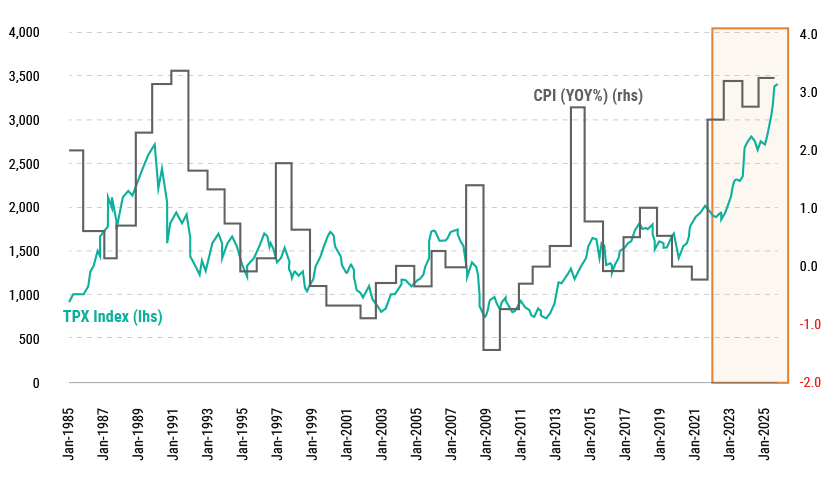

Japanese Equities Rebound as the Economy Breaks Free From Deflation
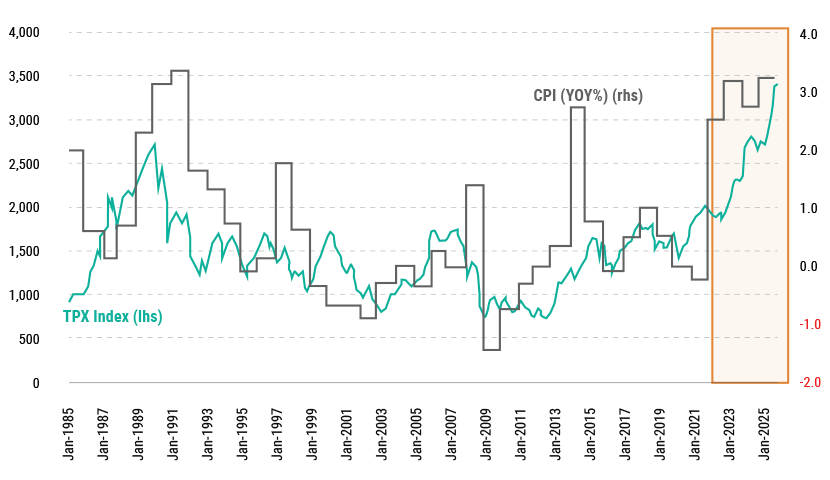
Source: Tokyo Stock Exchange, Bloomberg, Ministry of Internal Affairs and Communications. Topix Index as of December 2025. CPI as of 19 March 2026.
While economists may debate the drivers behind this transition, one factor stands out: demographic change. Japan’s productive capacity has continued to shrink as the country’s working‑age population declines, while the total population decline has been more gradual. The result is an environment in which aggregate demand persistently exceeds supply – suggesting that Japan’s return to inflation is structural rather than cyclical and marks the beginning of a long‑term regime shift.
Having been in the market for decades, we vividly recall how Japanese equities were dismissed throughout the deflationary 2000s and 2010s – a phenomenon often referred to as “Japan Passing.” Today, however, Japan’s shift toward moderate inflation has fundamentally altered the investment landscape. With Japan being one of the world’s largest economies, Japanese equities have re‑emerged as a market that global investors can no longer afford to overlook.
While structural reinflation is set to re-energize the Japanese stock markets, stock selection remains key. We believe PineBridge’s edge lies in our distinct and differentiated investment approach, which we call Lifecycle Categorization Research (LCR).
How we invest differently
Consistent with other strategies on our global equity platform, rather than classifying companies by traditional industry sectors, our LCR framework groups businesses by their stage of growth and degree of cyclicality. In an era when companies are expanding their businesses beyond historical industry boundaries, we believe that business adaptability – not sector labels – is what truly matters. Our approach focuses on three core questions:
Where does the company stand in its growth lifecycle today?
Where is it likely to move in the medium term?
How much of that evolution is already priced into the market?
The LCR framework: why it matters
Through LCR we categorize companies across six lifecycle buckets, defined by Growth vs. Mature and Stable vs. Cyclical companies. This enables us to formulate valuation and return expectations tailored to each category, emphasizing medium- to long-term opportunities over a three- to five-year horizon. Markets frequently overlook lifecycle transitions – and this is precisely where our research aims to uncover alpha.
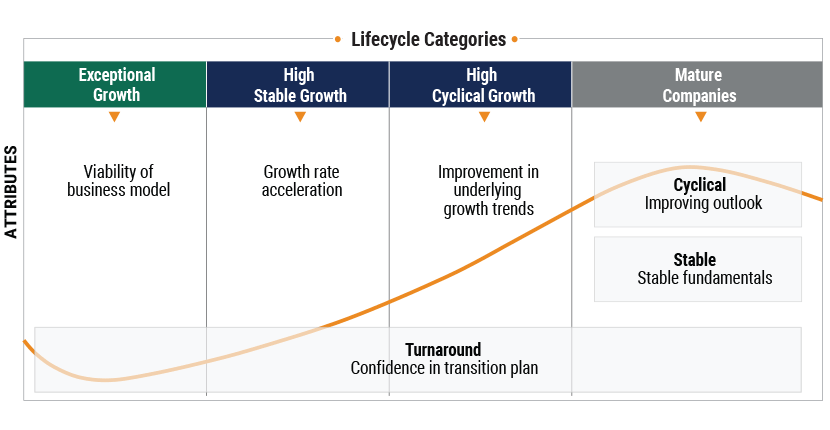
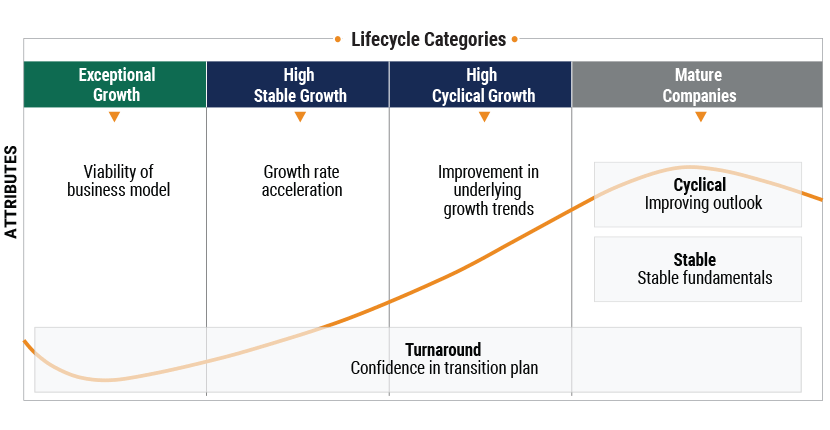
For illustrative purposes only
When conducting company analysis, the factors and criteria under evaluation vary depending on the company’s stage in its lifecycle. A distinct strength of our process is that all portfolio managers and analysts share a unified understanding of these lifecycle differences. This shared perspective shapes how we engage with management teams, build earnings forecasts, conduct valuation analyses, and ultimately make investment decisions.
Two examples demonstrate how this applies in Japanese equities:
Mature cyclical companies
Many Japanese companies fall into this category. Here, the critical question is whether we can identify early signs of a trough before a clear recovery appears in financial results. By the time a recovery becomes obvious, share prices have often already risen in turn. This underscores the value of rigorous industry analysis, continuous company engagement, and thorough research into domestic and global competitors – enabling us to spot bottoming-out opportunities ahead of the market.
Identifying companies poised for lifecycle upgrades
Changes in a company’s lifecycle do not always follow a linear path; growth does not inevitably lead to maturity. And contrary to common perception, mature cyclical companies can also transition back into a high cyclical growth phase. For example, a traditional car manufacturer expanding into the electric vehicle market may reignite its growth potential. Recognizing these inflection points is another vital source of alpha potential. Business environments evolve, and strategic decisions – including M&A – can materially alter a company’s growth trajectory. When such transitions occur, investors can benefit not only from earnings acceleration but also from expansion in valuation multiples, creating the potential for substantial returns.
Beyond stock selection, LCR also informs portfolio construction, helping us maintain high active share while controlling risk. It acts as a telescope into the investment universe, allowing us to identify underappreciated catalysts and build portfolios that deliver high-conviction, stock-specific alpha potential.
Disclosure
MetLife Investment Management (“MIM”), which includes PineBridge Investments, is MetLife, Inc.’s institutional investment management business. MIM is a group of international companies that provides investment advice and markets asset management products and services to clients around the world. The various global teams referenced in this document, including portfolio managers, research analysts and traders are employed by the various legal entities that comprise MIM.
All investments involve risk, including possible loss of principal; no guarantee is made that investments will be profitable. This document is solely for informational purposes and does not constitute a recommendation regarding any investments or the provision of any investment advice, or constitute or form part of any advertisement of, offer for sale or subscription of, solicitation or invitation of any offer or recommendation to purchase or subscribe for any securities or investment advisory services. The views expressed herein are solely those of MIM and do not necessarily reflect, nor are they necessarily consistent with, the views held by, or the forecasts utilized by, the entities within the MetLife enterprise that provide insurance products, annuities and employee benefit programs. The information and opinions presented or contained in this document are provided as of the date it was written. It should be understood that subsequent developments may materially affect the information contained in this document, which none of MIM, its affiliates, advisors or representatives are under an obligation to update, revise or affirm. It is not MIM’s intention to provide, and you may not rely on this document as providing, a recommendation with respect to any particular investment strategy or investment. Affiliates of MIM may perform services for, solicit business from, hold long or short positions in, or otherwise be interested in the investments (including derivatives) of any company mentioned herein. Views may be based on third-party data that has not been independently verified. MIM does not approve of or endorse any republication of this material. This document may contain forward-looking statements, as well as predictions, projections and forecasts of the economy or economic trends of the markets, which are not necessarily indicative of the future. Any or all forward-looking statements, as well as those included in any other material discussed at the presentation, may turn out to be wrong.