

2026 Asia Fixed Income Outlook: Tested Again. Resilient Again.

Omar Slim, CFA
Co-Head of Asia Fixed Income

Andy Suen, CFA, FRM
Co-Head of Asia Fixed Income
Asia defied expectations in 2025, delivering resilience despite tariff headwinds and global uncertainty.
Credit markets mirrored macro strength, with Asia investment grade (IG) and high yield (HY) posting solid returns and attracting renewed investor interest.
Our 2026 outlook remains broadly constructive, with manageable growth moderation and selective opportunities across sectors and credit segments.
Within IG, we favor a select number of banks and insurers, some corporates exhibiting steady fundamentals, and select quasi-sovereign entities, which still have room to compress against sovereign curves.
HY opportunities span sectors, from India’s renewables to Macau’s gaming sector, along with selective plays in Japan technology, media, and telecommunications (TMT) companies and Australian commodities.

Asia’s economy surprised to the upside in 2025. Despite tariff pressures and global uncertainty, the region demonstrated resilience few anticipated. Exporters accelerated shipments ahead of tariff deadlines, exemptions in the second half of the year eased the impact, and strong domestic demand kept growth on track.
Asia’s credit markets reflected this strength. Both investment grade (IG) and high yield (HY) segments delivered solid performance, aided by limited direct exposure to US trade disruptions and a favorable macro backdrop.
Looking ahead to 2026, we expect growth to moderate as the impact of export frontloading fades. Nevertheless, the slowdown should be orderly and well-contained. Inflationary pressures across the region are expected to ease further, giving central banks greater scope for accommodative policy.
Broadly, Asia credit markets should remain well anchored. While broader market credit spreads have tightened, pockets of value remain given the dispersion of returns and fundamentals. For investors, Asia continues to offer compelling opportunities across credit markets, even as structural shifts reshape the landscape.
Asia’s Growth Stayed Resilient in 2025, With India Leading and China Stabilizing
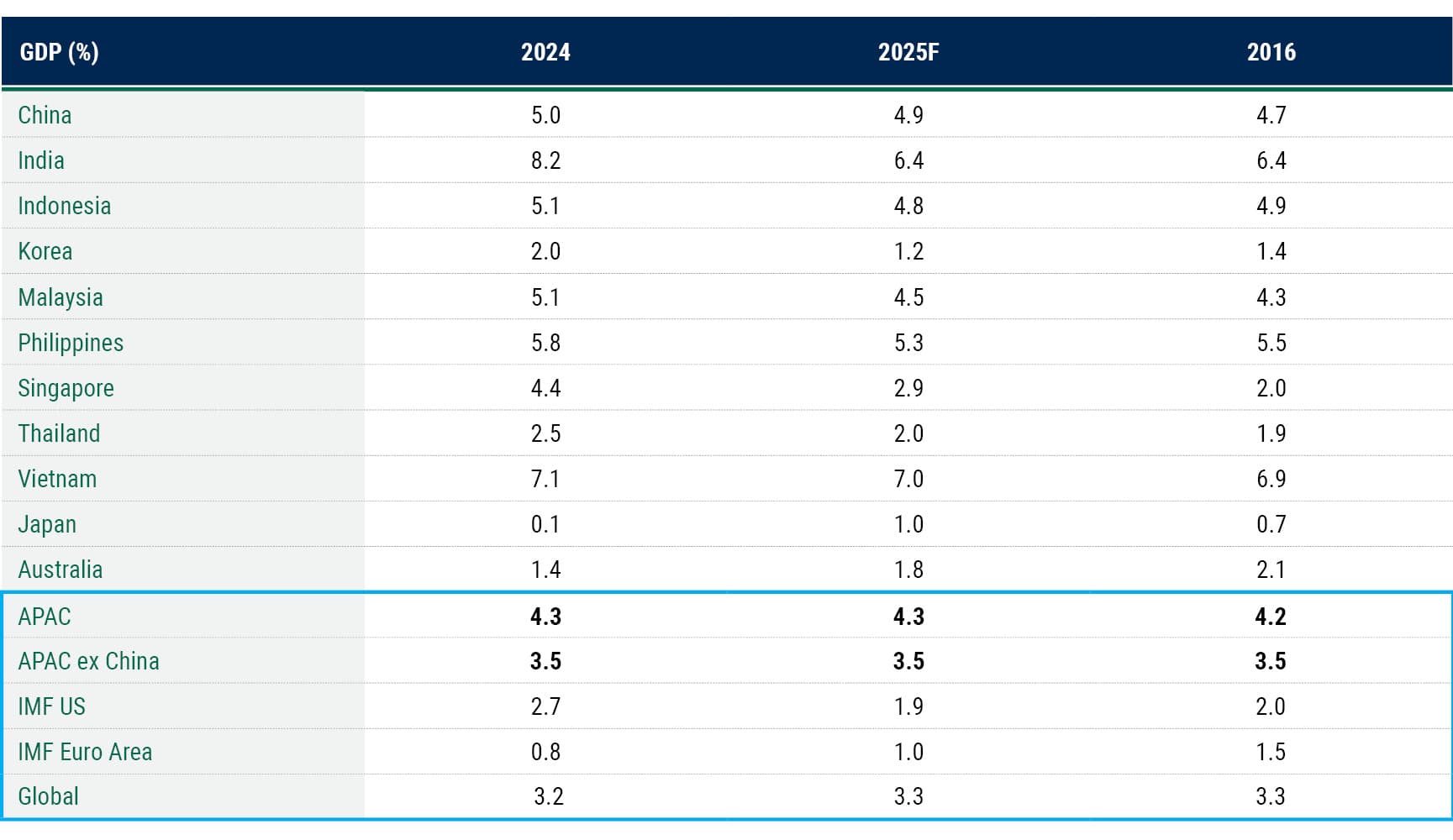
Source: PineBridge Investments estimates for Asian countries and IMF World Economic Outlook for others. Actual data as of 31 December 2024, forecast for 2025 and 2026 as of 26 November 2025. For illustrative purposes only. Any opinions, projections, forecasts, or forward-looking statements presented are valid only as of the date indicated and are subject to change. Diversification does not necessarily ensure against market loss. Past performance, or any prediction, projection, or forecast, is not indicative of future performance. In the calculation of GDP growth impact (ppt), we adopted an assumption on US import elasticity, -2 for China, and -1 for the remaining countries, using in-house model-calculated effective tariff rate.
Country Insights
China’s growth stabilized in 2025 and is expected to remain subdued but well managed in 2026. With the launch of its 15th Five-Year Plan and a roughly 5% growth target, Beijing will balance between stimulus and reform, with the former likely if exports weaken. We expect the China-US relationship to remain competitive: the current truce should hold through 2026, albeit with occasional friction. Recent signs of cooperation, such as on fentanyl precursors, suggest the status quo could even marginally improve.
Japan was hit harder than expected by tariffs, impacting export-oriented sectors like autos. Inflation has moderated, and the Bank of Japan is expected to maintain a cautious stance, with only gradual, minimal rate hikes. We see megabanks and insurers benefiting from monetary normalization, thanks to better net interest margins and higher investment yields. More importantly, we do not expect a return to Abenomics – the policy landscape has fundamentally changed.
India stood out in the region for attracting the harshest US tariffs. Nevertheless, its GDP held firm and, as we anticipated last year, its sovereign credit rating was upgraded to BBB from BBB- by S&P Global Ratings. We expect India to remain the fastest-growing major economy in 2026, with structural reforms and robust domestic consumption continuing to underpin its trajectory.
Indonesia faces negative sentiment driven by soft domestic consumption, fiscal restraint, and trade disruptions. Risks of missed fiscal targets and institutional erosion worry investors further. We think growth will subside in 2026, and investor confidence may hinge on fiscal discipline and governance improvements.
Thailand remains a regional laggard, weighed down by structural challenges and fresh shocks. The loss of Chinese tourism, export headwinds, and political uncertainty ahead of the March 2026 general election, along with recent severe flooding in southern provinces, will keep growth sluggish. Monetary policy will likely stay dovish as a result, while election-related delays and a weaker baht add to near-term risks.
Asia IG demonstrates stability and issuance momentum
Asia IG posted another strong year, with a 7.44% total return1 through November, underscoring its resilience amid headline risks. Fundamentals remain solid, and we expect the higher issuance seen in 2025 to ramp up even further in the new year, with Japan and Australia driving supply. Year-to-date through November, these two markets accounted for over 40% of total Asia-Pacific issuance.
Sentiment toward the asset class remains positive. We see limited fallen angel risk, while the shift in the asset class’s composition offers diversification benefits.
Change in USD Credit Index Market Size: China Down, Japan and Australia Up
US$ bil.
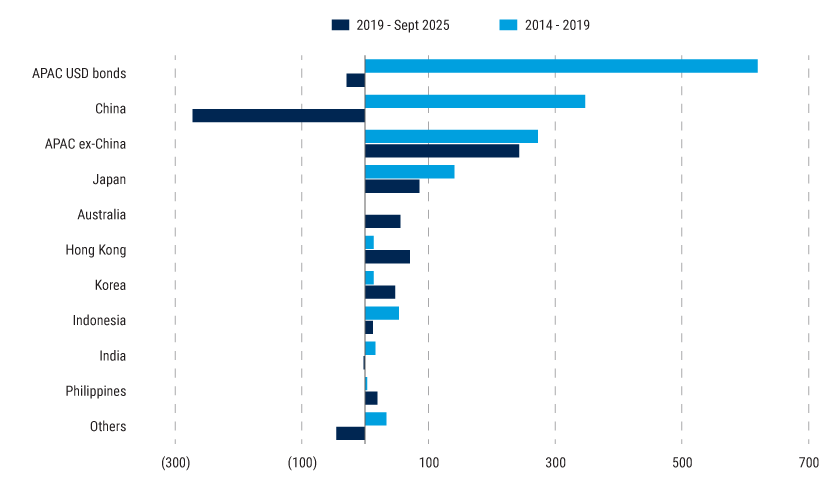
Source: PineBridge, JP Morgan, and Bloomberg as of 30 September 2025. For illustrative purposes only. Any opinions, projections, forecasts, or forward-looking statements presented are valid only as of the date indicated and are subject to change. Diversification does not necessarily ensure against market loss. Past performance, or any prediction, projection, or forecast, is not indicative of future performance.
Furthermore, Asia IG corporates carry substantially lower leverage than their IG peers in the US and Europe – underscoring the structural strength of Asia credit and its appeal to global investors.
Within IG, we favor some capital securities from banks and insurers, some corporates, and select quasi-sovereign entities, which still have room to compress against sovereign curves.
Asia HY sees investor re-engagement and attractive relative value
Asia HY delivered a 9.81% total return2 year-to-date through November, supported by improving fundamentals. With the transformation of the asset class over the past few years – driven by reduced exposure to Chinese property – we see renewed interest from investors. Defaults remain negligible outside China property bonds, and maturities in 2026 appear manageable, totaling about US$15 billion (or roughly 9% of the overall market).3 Default rates should stay low, supported by solid fundamentals and improved access to local funding.
Adding to the segment’s appeal is improving credit quality, with rating upgrades having significantly outpaced downgrades. Meanwhile, Asia HY’s relative valuations remain compelling, given yields of approximately 8.61%,4 compared with yields of roughly 6.57% for US HY (as of 28 November 2025).
Asia HY Rating Upgrades Have Been Outpacing Downgrades
Rolling 12-month rating trend
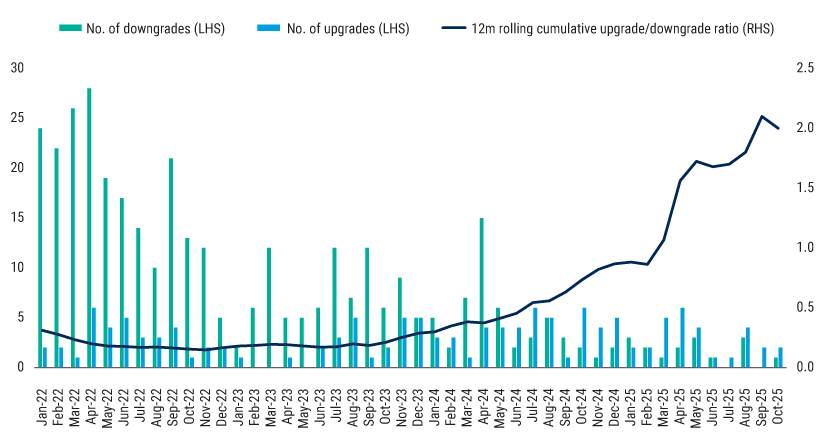
Source: JP Morgan and PineBridge Investments as of 31 October 2025. For illustrative purposes only. Any opinions, projections, forecasts, or forward-looking statements presented herein represent the views of the manager, are valid only as of the date of this document, and are subject to change.
Going into 2026, we remain selective even while broadly constructive on the asset class. Within commodities, precious metals should outperform oil and gas. In India, a strong macro backdrop supports opportunities in renewables, non-banking financial companies (NBFCs), and infrastructure. We also like the continued deleveraging in Macau’s gaming sector, even if the pace slows in the new year. China industrials benefit from growth stabilization and improved funding access. Meanwhile, Japan’s technology, media, and telecom (TMT) space and Australia’s commodities sector offer compelling options for yield enhancement.
Asia holds steady
In contrast to concerns around fiscal and current account deficits in select developed economies, most AsiaPacific countries maintain prudent fiscal positions and healthy current account surpluses, providing stability and reducing reliance on external financing. Asia remains resilient amid shifting trade dynamics and continues to offer compelling opportunities for selective investors.
These dynamics, combined with growing investor interest in diversifying away from US assets, underpin our positive stance on Asia-Pacific hard currency bonds. Asia-Pacific USD credit stands out for its attractive risk-adjusted relative value versus developed market bonds and should stay well anchored, even in the face of global volatility.
For more insights into the trends moving markets in the coming year, see our 2026 Investment Outlook.
Disclosure
MetLife Investment Management (“MIM”), which includes PineBridge Investments, is MetLife, Inc.’s institutional investment management business. MIM is a group of international companies that provides investment advice and markets asset management products and services to clients around the world. The various global teams referenced in this document, including portfolio managers, research analysts and traders are employed by the various legal entities that comprise MIM.
All investments involve risk, including possible loss of principal; no guarantee is made that investments will be profitable. This document is solely for informational purposes and does not constitute a recommendation regarding any investments or the provision of any investment advice, or constitute or form part of any advertisement of, offer for sale or subscription of, solicitation or invitation of any offer or recommendation to purchase or subscribe for any securities or investment advisory services. The views expressed herein are solely those of MIM and do not necessarily reflect, nor are they necessarily consistent with, the views held by, or the forecasts utilized by, the entities within the MetLife enterprise that provide insurance products, annuities and employee benefit programs. The information and opinions presented or contained in this document are provided as of the date it was written. It should be understood that subsequent developments may materially affect the information contained in this document, which none of MIM, its affiliates, advisors or representatives are under an obligation to update, revise or affirm. It is not MIM’s intention to provide, and you may not rely on this document as providing, a recommendation with respect to any particular investment strategy or investment. Affiliates of MIM may perform services for, solicit business from, hold long or short positions in, or otherwise be interested in the investments (including derivatives) of any company mentioned herein. Views may be based on third-party data that has not been independently verified. MIM does not approve of or endorse any republication of this material. This document may contain forward-looking statements, as well as predictions, projections and forecasts of the economy or economic trends of the markets, which are not necessarily indicative of the future. Any or all forward-looking statements, as well as those included in any other material discussed at the presentation, may turn out to be wrong.

Recent Insights